NYC Subway Map: A Step-by-Step Guide
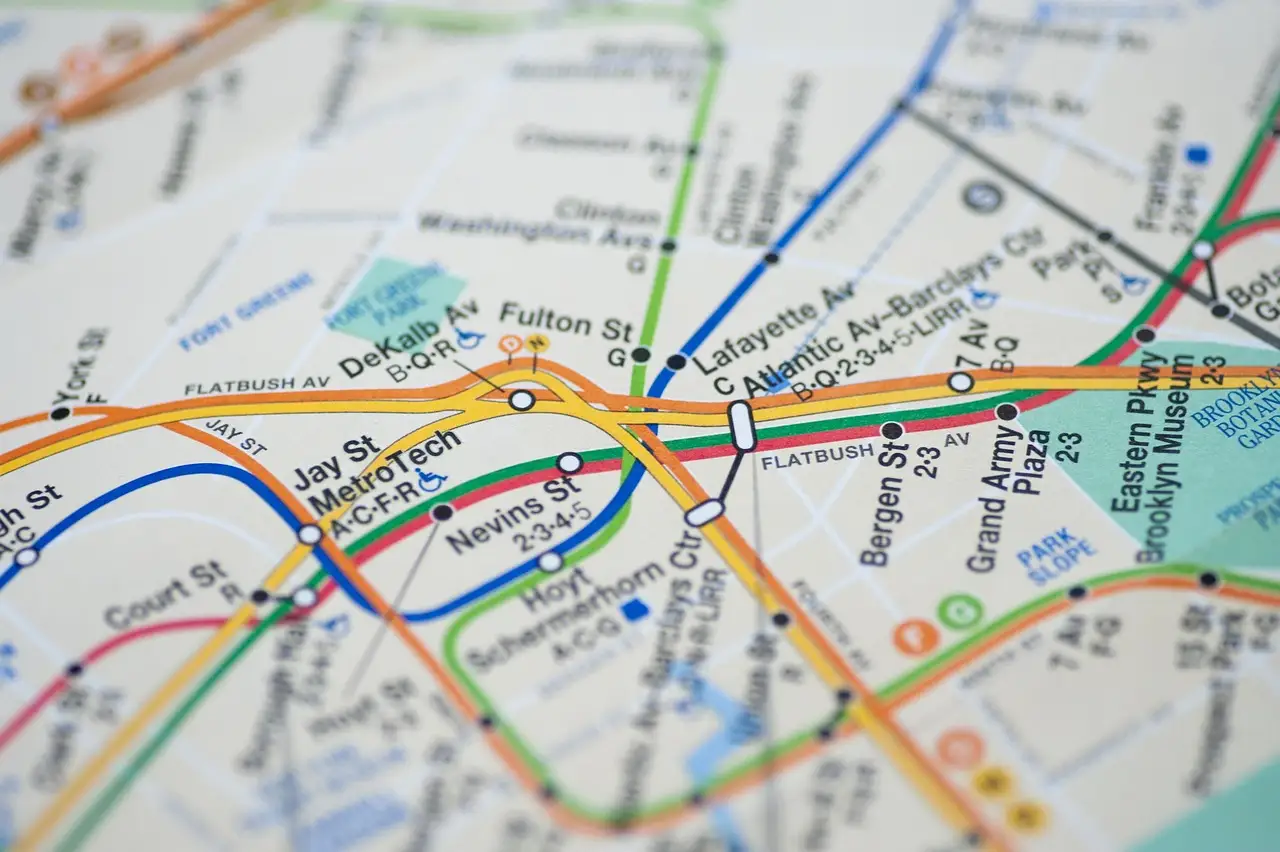
The NYC subway map comes from the MTA (Metropolitan Transportation Authority), and you pay for each ride by tapping a contactless card or phone. There is no day pass to buy, because a weekly cap on your fares does that job. The steps below cover the map, the payment, the right train and the MTA's safety tips.
Step 1: Find the NYC subway map and learn to read it
The MTA publishes the official NYC subway map, and its website, mta.info, is the place to look for the current version. The MTA's maps page lists the subway diagram, which shows typical weekday service, plus a late night diagram, a geographic map, an accessible-stations map and a large-type map. It also posts a weekend diagram for the current weekend, so pick that one on Saturday or Sunday. Open the page on your phone and save the map you want. The maps page does not say whether printed copies are handed out in stations or whether the map is free on paper, so ask a station agent. The MTA page lists maps to view or download, and today it shows a weekend diagram for October 23 to 26, 2026. The only sure way to have a map in hand is to save the online one to your phone before you go. A late night diagram also exists, and the MTA says newer trains show digital route maps inside.
Each route on the map is a letter or a number, such as the 1, the 7 or the A, and the colors show which Manhattan trunk line a train uses. Pick your start station, find your end station, and follow one line at a time. When the two stations share no line, look for a station where two lines meet and change trains there. The MTA's rider guide does not explain how to plan a transfer on the map. It says to talk to an MTA employee, dial 511, use the MTA trip planner or download the MTA app. In short, plan a transfer by asking staff or using the trip planner, because the map alone is not enough, and the guide adds that that if you miss your stop, you stay on the train until a station where you can switch to a train going the other way, so read the signs in the station. The MTA also says its app shows live service status and arrival times, which helps when a line is changed.
The subway is only one way to move around, and for safety the MTA's guide gives general tips and no advice that is specific to night rides. The subway runs 24 hours a day, 7 days a week, 365 days a year, so the same tips apply at night, and the late night diagram on the maps page shows how service changes after dark: ask a station agent or use a blue Help Point, and to report a crime in progress, tell an MTA employee or police officer, use a Help Point or call 911 right away. The MTA also says to check service status before you go, keep your belongings in sight and, if you use a stroller or mobility device, board near the center of the train, where the conductor usually is. The MTA's core tips are to stand back from the platform edge, stay off the tracks and hold on when the train is moving. It sits next to buses, taxis and every New York ferry. The Staten Island Ferry is the cheap one, because the city runs it for free and it never closes.
| Step | What to do | What to watch for |
|---|---|---|
| 1. Map | Find the current MTA map | Use the newest date |
| 2. Pay | Tap a card or phone | Use the same one every ride |
| 3. Train | Check line, direction, stops | Local or express |
| 4. Ride | Stay alert | Stay behind the edge |
| 5. Other options | Compare a bus or pass | They are not a fare |
Pro Tip Tap the same card or phone for every ride this week. A plastic card and the same card in your phone's wallet count as two different payment methods.
Step 2: Pay with OMNY and skip the pass hunt
You pay for the subway by tapping a contactless credit card, debit card, phone or watch at the turnstile reader. OMNY, the MTA's tap-to-pay system, accepts any card that shows the contactless symbol. Wait for the reader to say "GO" before you walk through.
On New York's subway and local buses a ride costs $3, and OMNY stops charging once the same card or phone has paid $35 in 7 days, according to the 2026 New York City Travel Cost Study (MTA and OMNY fares, read 24 October 2026).
There is no day pass. On tour versus going it alone, the subway needs no booking and no set time, and each ride costs the base fare above, while the bus ticket costs from €55 per person and needs a day you pick in advance. the do-it-yourself way is the cheapest for getting around, because you pay only the base fare per ride, while a bus ticket from €55 per person buys a guided loop but not a faster way across the city. A tour is worth it only if you want a ready-made route past the big sights, and you need no tour to ride the subway. Three rides on your own cost three times the base fare, while the bus ticket is one price from €55 per person for 1 to 3 days. That weekly cap replaces a pass, and it starts on whichever day you first tap. OMNY's fare cap page says it only counts taps from the exact same card, phone or watch, and that free transfers do not count toward it.
Here is how the payment options compare:
| Way to pay | Counts toward the cap? | Good to know |
|---|---|---|
| Contactless card | Yes, for that card | Look for the contactless symbol |
| Phone or watch | Yes, for that device and card | A different cap from the plastic card |
| OMNY Card | Yes, for that card | Load it with cash at a machine |
A few more rules save money:
- A transfer is free if you use the same payment method within two hours of your first tap.
- One card or phone can pay for up to three more riders, but only the first tap counts toward the cap. Each adult should tap their own.
- Children 44 inches (about 1.12 m) and under ride free, up to three per paying adult, under the MTA's passenger tariff.
- MetroCards can no longer be bought or refilled, though any value left on one still works.
If you ride only a few times, you will never reach the cap. You simply pay the base fare each time, and that is fine.
A pass for sights is a different thing. The New York Pass starts at €151 per person on GetYourGuide and covers 100+ attractions. Its listing names attractions and an app, not subway rides, so you would still tap in for your trains.
Key Takeaway New York has no subway day pass. The weekly cap does what a pass would, but only if you tap the same card or phone each time.
Step 3: Pick the right train and direction
Check three things before you board: the line, the direction and whether the train stops where you need it. Express trains skip some stops, and local trains make them. The MTA's rider guide does not explain local and express trains, so read the signs on the platform and on the train itself.
Direction is simple in Manhattan. Uptown means north, toward Harlem, and downtown means south, toward the Battery. Pick the platform for your direction before you tap through, because the signs above the stairs show it.
The MTA's rider guide gives no figure for how often trains come, and we do not guess one. The subway runs 24 hours a day, every day, according to the MTA's riding guide.
A map shows where the lines go, but only the signs in the station tell you which train is coming.
Step 4: Ride the subway safely
The MTA's tips for staying safe are short and practical. Its riding guide says to stand back from the platform edge, never go onto the tracks and keep your belongings in sight. It gives no safety rating of the system, so we offer none.
If you need help, find a station agent or a blue Help Point. Use the red button for an emergency and the green one for information.
Some trips are the wrong fit for the subway for some trips. Not every station has an elevator, so a trip with a stroller, a wheelchair or heavy bags needs planning. Check the elevator status on the MTA's site before you leave. For night rides, the MTA gives no extra rules beyond its general tips. Check the late night diagram before you go, stand where you can see the platform, and tell an MTA employee if you drop something on the tracks instead of reaching for it.
Step 5: Skip the subway when sightseeing is the goal
If you want to see the sights without planning train changes, a bus can work better than the subway. The hop-on hop-off New York page compares the main bus tours and what each ticket includes.
Things to Do in NYC's count of GetYourGuide listings in October 2026 found 4 hop-on hop-off bus listings, from €35 to €121 per person.
One option is the Big Bus hop-on hop-off ticket, from €55 per person on GetYourGuide. It carries a 4.2 rating from about 6,600 reviews, and its page says you can hop on and off for 1 to 3 days. Big Bus Tours runs it, and the tour card shows free cancellation. The card does not state a group size, so we give none. The tour page lists attraction admission as not included, and it does not include hotel pickup, so you walk to the meeting point yourself. Plan for a ticket that works for 1 to 3 days, not a fixed tour length, and expect to pay extra at the sights you hop off at. Neither the bus nor the pass listing gives a group size, since you ride a regular loop and enter sights on your own. The card names Big Bus Tours as the operator and 724 7th Ave as the meeting point, and it shows free cancellation, so check the card for the cancellation terms before you book. The pass listing, from €151 per person, covers 100+ attractions, but it names no subway rides. The bus suits first-time visitors who want a simple loop. It is a poor fit if you only need to reach one place fast, or if you plan to skip paid sights.
A bus ticket is not a substitute for the subway on every trip. Do-it-yourself with the subway costs less and lets you go straight to one spot, while the bus suits a first-time visitor who wants an easy loop past the big sights. In plain numbers, a day of subway rides costs the base fare for each ride, while the bus costs from €55 per person for a 1 to 3 day ticket, and you also pay at the sights you enter. The bus is slower for crossing the city to a single spot, so keep tapping your card or phone for those rides.
See the sights without planning every train
Doing it yourself means tapping in for each ride and reading the signs, with no booking and no set time. A bus ticket costs more but shows the sights in one loop. A hop-on hop-off bus ticket starts at €55 per person, and the New York Pass starts at €151 per person for 100+ attractions. Neither one is a subway ticket, so you still tap in for the subway. The bus is run by Big Bus Tours, rated 4.2 from about 6,600 reviews, with free cancellation and a meeting point at 724 7th Ave. It does not include hotel pickup, and the listing gives no group size or fixed tour length. The bus ticket is valid for 1 to 3 days, does not cover attraction entry and has no group size listed, and you meet at the stop yourself, so budget extra for sights. Going it alone by subway needs no booking and costs only the base fare per ride, so the bus is worth it only if you want one easy loop. The pass is valid for 1 to 10 days and is not suitable for wheelchair users.
-
Big Bus hop-on hop-off ticket
from €55 per person
An open-top bus that stops at the big sights, for days when you would rather not work out train lines between them.
Valid 1–3 days 4.2 (6,607 reviews) Free cancellation
Run by Big Bus Tours - New York
Check availability: Big Bus hop-on hop-off ticket on GetYourGuide -
New York Pass
from €151 per person
An attraction pass for readers who plan to visit many paid sights, though its listing does not name subway rides.
Valid 1–10 days 4.6 (2,629 reviews) Free cancellation
Run by Go City - NYC Pass · not suitable for wheelchair users
Check availability: New York Pass on GetYourGuide
Prices and ratings as shown on GetYourGuide on 24 October 2026.
Hop-on hop-off and bus tours in New YorkFAQ
How do I use the NYC subway?
Is the NYC subway safe?
How much is a New York City subway pass?
How and where do I buy a New York City subway pass?
Is there a day pass for the New York City subway?
Does the New York Pass include the subway?
Conclusion
The NYC subway map is easy once you know three things. Follow one letter or number at a time, tap the same card or phone for every ride, and read the signs before you board. If your day is mostly sightseeing, a bus ticket or a pass can take the pressure off, but the subway still gets you across the city for the base fare.
Related guides
Sources
- Metropolitan Transportation Authority, OMNY Fare Cap FAQ, last checked 24 October 2026
- Metropolitan Transportation Authority, OMNY Tap and Ride, last checked 24 October 2026
- Metropolitan Transportation Authority, Riding the Subway, last checked 24 October 2026
- Metropolitan Transportation Authority, Passenger Tariff (effective January 4, 2026), last checked 24 October 2026
- Metropolitan Transportation Authority, Maps, last checked 24 October 2026
- NYC Department of Transportation, Staten Island Ferry, last checked 24 October 2026